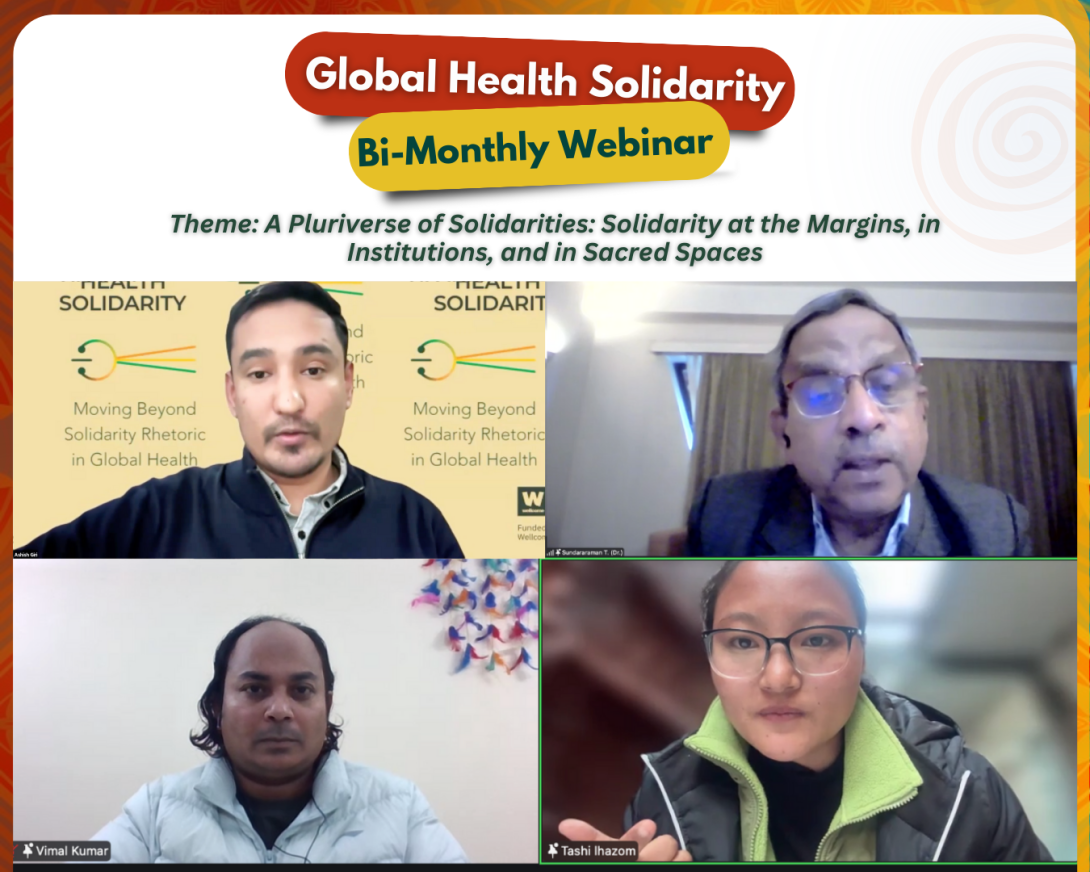
The Global Health Solidarity Project hosted its 6th and final Bi-Monthly Webinar of 2025, bringing together influential voices from India and Nepal to examine what solidarity looks like in South Asia. Held under the theme “A Pluriverse of Solidarities: Solidarity at the Margins, in Institutions, and in Sacred Spaces,” the session built directly on insights from September’s South Asia Regional Workshop in New Delhi.
Participants joined from around the world as three speakers, Dr. Vimal Kumar, Tashi Lhazom, and Prof. Sundararaman Thiagarajan, brought to life what solidarity looks like at the margins, in communities, and inside institutions. Their stories revealed how solidaristic action emerges from lived struggle, and how systems often constrain, shape, or erase it.
The enduring burden of the caste system
Dr. Vimal Kumar, founder of the Movement for Scavenger Community, delivered a searing account of caste-based discrimination and the structural erasure of Dalit and manual scavenging communities in India. Across generations, Dalit and scavenger communities inherit both stigma and danger. They are denied basic services, punished through ritual practices, and expected to absorb society’s “impurities.” Speaking from lived experience and decades of grassroots organising, he described how caste shapes every layer of social life, from where people are forced to live, to who is deemed “clean,” to who is even allowed to speak in public forums.
Yet, he emphasised that marginalisation has also forged deep internal solidarity.
“We don’t have support from outside… so this situation created, among our society, an atmosphere of solidarity.”
He challenged participants to consider whether true solidarity is possible in structures built on centuries of exclusion: “If we have this system rooted in our society, can we really think about solidarity?”
Climate Crisis, Indigenous Rights, and the Politics of Visibility
Youth climate advocate and filmmaker Tashi Lazhom transported participants to the Limi Valley of north‑western Nepal, a region often romanticised for its mountains, yet neglected in policy and disaster response. She described how communities are expected to “own” climate problems despite lacking structural support. “While Everest commands global attention for every avalanche or landslide, equally devastating disasters in less publicised regions go unnoticed,” she said.
“In my community, when disasters happened, we were told that the gods were angry, not that the climate was collapsing. We didn’t have the information, and for a long time no one explained what was really happening to us. That’s what historical marginalisation looks like: when you are left to interpret a crisis with whatever little knowledge you’ve been given.”
She emphasised that solidarity must be rooted in empowering people to lead rather than speaking on their behalf and that solidarity places people at the centre, often involving standing up against systems and structures. As one of the selected GenZ leaders of the successful political uprising in Nepal, she highlighted the strength of decentralised, issue‑driven movements, pointing to anti‑corruption campaigns as examples of how collective action can succeed when centred on shared concerns rather than individual personalities.
When Systems Enable, and When They Undermine, Solidarity
Prof. Sundararaman Thiagarajan , an influential health policy thinker, linked the grounded testimonies of earlier speakers to broader structural realities. Tracing the historical roots of solidarity in health, he reminded participants that it emerged from early worker‑led risk‑pooling schemes in Germany, widely known as the Bismarckian Social Health Insurance model, and later tax-financed state health systems. Solidarity, he argued, is fundamentally a collective response to uncertainty, vulnerability, and unequal power.
“Healthcare is “not a commodity” yet much of global health policy treats it as one, creating misaligned incentives and eroding trust” – Prof. Sundararaman
Institutional structures, he warned, can either enable solidaristic practice or reinforce exclusion. “Most institutions are designed to embed, retain, and replicate hierarchy,” he added. He noted that the current systems, rooted in market logic, information asymmetry, and professional privilege, risk undermining the very communities they claim to serve.
He went on to reflect on the political barriers to global solidarity, pointing to a shifting geopolitical landscape marked by the resurgence of imperialist dominance. Whereas development aid was once framed as serving the collective good, it is now increasingly justified through nationalist agendas.
Against this backdrop, he closed with a strong appeal for renewed collective action, emphasising the need for people’s movements and progressive governments to challenge entrenched hierarchies and work toward building systems grounded in solidarity.
A Collective Call for a More Just Global Health Future
Across the presentations, one truth rang clear: solidarity is neither charity nor symbolic gesture. It is a lived practice forged in the crucible of trauma, exclusion, collective survival, and the relentless pursuit of dignity. It requires listening to voices long silenced, dismantling structures that perpetuate harm, and honouring the diverse ways communities resist, care, and imagine alternatives.
As the closing event of 2025, this webinar did more than reflect on past struggles; it issued a call to action. The challenge now is to carry these conversations forward into the coming year, transforming them into new forms of accountability, shared struggle, and collective imagination.
Watch the full webinar here: https://www.youtube.com/watch?v=fFA0RcnAp8U
Watch the webinar with French subtitles here: https://www.youtube.com/watch?v=Ae_NPLaDGR8
- Log in to post comments