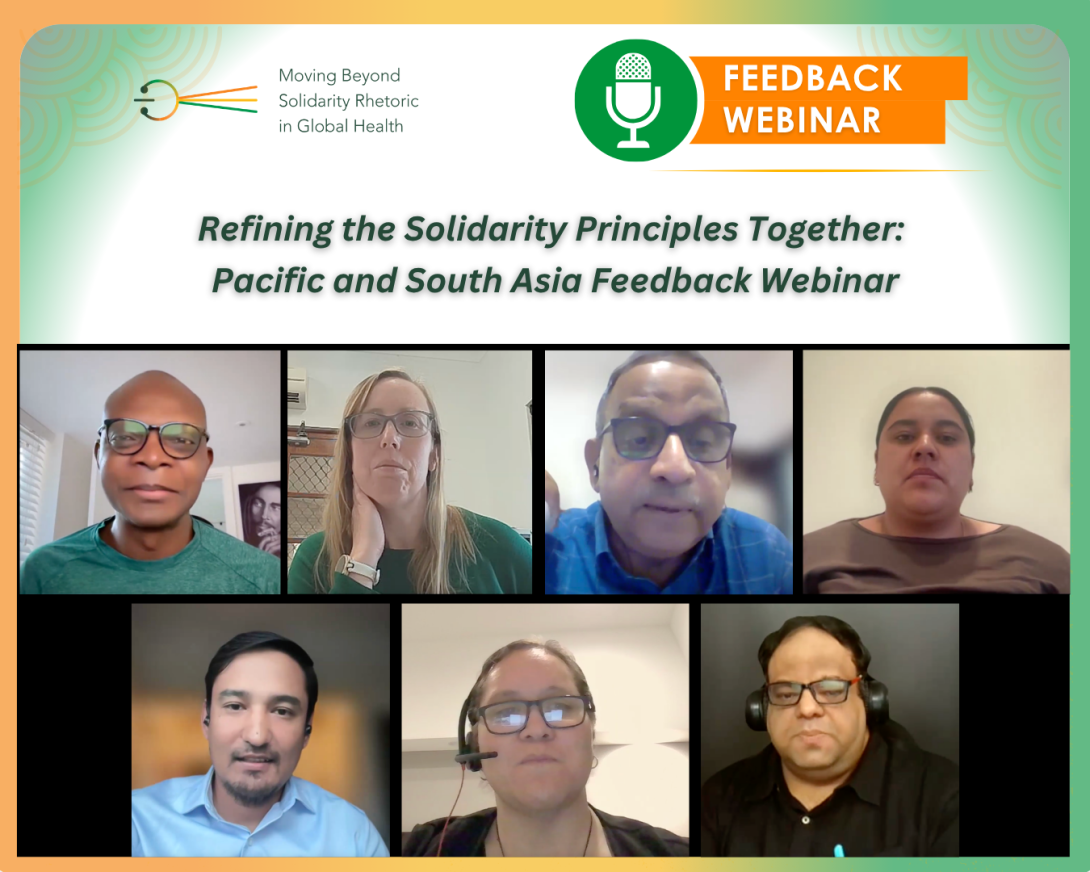
The Global Health Solidarity Project continued its Regional Feedback Webinar Series, “Refining the Solidarity Principles Together,” with its second regional dialogue, bringing together speakers and participants from the earlier Pacific and South Asia workshops.
The session gave participants an opportunity to see how insights from the workshops had informed the draft principles and to reflect on whether the framework adequately captures how solidarity is understood and practised across their contexts. The webinar centred four invited reflections, followed by a wider discussion among participants from the Brisbane and Delhi workshops.
Dr. Bridget Pratt, Co-Investigator on the GH-Solidarity Project, opened by tracing how regional workshops, literature reviews and interviews shaped the draft principles, before Ashish Giri, the project’s Manager for the Indian subcontinent, presented them. They serve as an evolving standard for reflection and practice that can support dialogue, inform funding and research partnerships, and eventually underpin practical tools.
The dialogue both affirmed and stretched the draft principles. Speakers recognised the progress made in articulating solidarity across diverse contexts, while also challenging the project to ensure that the final framework is practical, accountable to the communities that helped shape it, attentive to power, and open to different ways of knowing and organising health.
Prof. Sundararaman Thiagarajan, a leading Public Health Expert and long-standing member of the People’s Health Movement in India, welcomed the project’s effort to bring solidarity back to the centre of public health thinking.
“We have set up a discourse around solidarity that clarifies how we, as a public health community, understand it. The principles give us that language.”
His central challenge was what comes next: how the principles can move beyond discourse and become a resource that institutions and actors across global health can use to examine and change existing practices. For Prof. Sundararaman, their value will ultimately depend on whether they can help address real problems within the health system.
Dr. Krushil Watene, Associate Professor in Philosophy at the University of Auckland, similarly offered a strong endorsement of the framework.
“The principles are a necessary step in reclaiming solidarity as a normative pillar in global health. They remind us that solidarity is not optional, but foundational to justice and equity.”
Her reflection also encouraged the project to make the diverse conceptual roots of the framework more visible, particularly by showing more explicitly how different stories, dialogues, knowledge traditions and understandings of solidarity from around the world have contributed to its development.
Atarangi ‘Langi’ Kepu-Kosene-Apiata, a New Zealand-registered Nurse, Researcher and Clinical Leader with Iwi United Engaged Ltd, described the nine principles as a valuable foundation, noting clear connections with relationships, meaningful participation, equity and power from a Māori perspective. She urged the framework to go further in addressing what meaningful redistribution of power require, including who controls funding, sets priorities, governs data, makes decisions and ultimately benefits from them.
Dr. Anant Bhan, a Researcher and Practitioner working across bioethics, mental health, global health and health policy at Bhopal Hub, Sangath, India, cautioned against allowing solidarity to become a tokenistic commitment. He called for greater clarity around accountability, particularly regarding what different actors, including funders, institutions, researchers, policymakers and communities, are responsible for when it comes to advancing solidarity.
Beyond the invited speakers, contributors from the Pacific and South Asia workshops affirmed the importance of meaningful participation, equitable partnerships, trust, accountability and power-sharing. They reinforced the value of recognising local and Indigenous knowledge, diverse experiences and existing community networks, while considering how the principles can remain relevant across different contexts and avoid becoming a purely aspirational framework.
Reflecting on the feedback, Prof. Caesar Atuire, Principal Investigator of the Global Health Solidarity Project, noted that it will inform further refinement of the Solidarity Principles framework before it is translated into practical tools.
“If we refine these principles together now, they can move beyond theory into actionable tools that embed solidarity meaningfully in the global health funding ecosystem.”
The Global Health Solidarity Project extends its sincere thanks to speakers and participants who returned to share their knowledge, experiences and reflections.
Watch the Webinar here: Refining the Solidarity Principles Together
The Regional Feedback Webinar Series now moves to Mesoamerica, reconnecting with participants from the project’s Costa Rica workshop.
Event: Mesoamerica Feedback Webinar on the Solidarity Principles
Date: Tuesday, 22 September 2026
Time: 09:00 CST |15:00 GMT | 16:00 BST | 17:00 CEST | 18:00 EAT
Format: Virtual
Language: Spanish, with English translation
More information and registration details will be shared soon.
- Log in to post comments